Lead List Pricing in Canada: What a $1 Verified Lead Should Include
Key takeaways
- Compare lists on what each row contains, not just the headline price per lead.
- A $1 verified lead should include a checked business, contact details it published itself, the source and a reason to reach out.
- Deeper research, like extra signals or custom fields, is worth paying more for only when it changes who you contact or what you say.
- Cheap lists built from scraped directories or guessed emails bounce more and can create CASL problems.
- Ask for a free sample before you pay, and check a few rows yourself.
"How much does a lead cost?" has no single answer, because two lists with the same price can contain very different things. One gives you a name and a guessed email. The other gives you a business that was checked by hand, contact details it published itself and a reason to get in touch. This guide explains how lead list pricing works, what we include for $1 and what to watch for.
Why lead list pricing varies so much
Most of the cost of a lead is research time. A row pulled automatically from a database costs almost nothing to produce. A row where someone visited the business's website, confirmed it's open, found the contact details it publishes and noted why it fits your offer takes real work.
That's why the cheapest list is rarely the cheapest outcome. If half the emails bounce or the businesses don't fit, you paid for rows you can't use, and your sending reputation takes the hit.
Common ways lead lists are priced
Lead providers usually charge in one of four ways:
| Model | How it works | Good for |
|---|---|---|
| Pay per lead | A set price for each row you receive | One-off campaigns and testing a new market |
| Credits or subscription | A monthly fee for a set number of exports from a database | Teams that pull lists every week |
| Database licence | Access to search a large database yourself | Large sales teams with their own researchers |
| Done-for-you research | A researched list built to your brief | Small teams that want fit over volume |
Our prospect lists are pay per lead and done-for-you: you describe who you want to reach, approve the brief, and we research each business. You only pay for verified leads that match it.
What a $1 verified lead includes
Our base tier is $1 CAD per lead. Every row includes:
- The business name and city, checked against its own website or listing to confirm it's open
- A phone number and email the business published itself, never a guessed pattern or a personal address
- Where we found the contact details, such as its contact page or website footer, so your outreach stays traceable
- A signal with evidence: the reason it's worth contacting, such as phone-only booking or a site that isn't mobile-friendly
- A fit score out of 5, so you can start with the strongest prospects
Closed businesses and bounced emails reported within 14 days are replaced free. You can see sample rows on our prospect lists page.
What makes some leads cost more than $1
Deeper research takes more time, so it's priced above the base tier and quoted with your free sample. Typical extras include:
- More than one signal per business, such as hiring activity plus an outdated website
- Custom fields, like opening hours, services offered or whether they take online bookings
- An outreach kit: a short intro email and a one-page "why partner with us" written for your business
- Hard-to-research lists, such as businesses that opened in the last six months, where every row needs a date and evidence
Pay for extras only when they change who you contact or what you say. If you'll send the same email to everyone anyway, the base tier is usually enough.
Cost per lead vs cost per conversation
The price per row matters less than what you pay for each useful conversation. Here's an illustrative example with made-up numbers:
- List A costs less per lead, but a third of the emails bounce and many businesses don't fit your offer.
- List B costs $1 per lead, every contact detail was published by the business, and each row comes with a reason to reach out.
List B costs more upfront, but more of its emails arrive, more of them are relevant and your opening line writes itself. The real cost per lead is what you spend divided by the leads you can actually use.
Why bounce rate matters
A high bounce rate does more than waste rows. Email providers watch how many of your messages fail, and repeated bounces can push your future emails into spam folders, including emails to your existing customers. Contact details a business published on its own site are far more likely to be current than an address guessed from a pattern.
Why there's a 100-lead minimum
Every list starts with the same setup work: reading your brief, agreeing what counts as a fit, deciding which signals to look for and checking a free sample with you. A 100-lead minimum keeps the per-lead price at $1 while covering that setup.
100 is also a useful size for a first campaign. It's enough to learn which signals get replies, and small enough that you can follow up with everyone personally. Monthly lists use the same minimum, so each month brings at least 100 new businesses, never repeated.
Red flags in cheap lead lists
Watch for these signs that a low price will cost you later:
- No source for contact details. If a provider can't tell you where an email came from, you can't show you had a basis to send it.
- Guessed emails like firstname@company.ca that the business never published
- Personal emails and mobile numbers instead of the business's own published contacts
- Rows copied from third-party directories. Canada's Federal Court of Appeal ruled in 2020 that addresses mined from third-party directories generally can't be relied on under CASL, as this law firm summary of the decision explains.
- No replacement promise for closed businesses or bounced emails
Our guide to CASL compliance for small business covers the consent rules in more detail.
How to test a list before you pay
Ask for a free sample, then check a few rows yourself. Open each business's website and confirm:
- The business is open and matches what you asked for
- The email and phone number appear on the page the list names as the source
- The signal is true and specific enough to mention in your first message
We send a free sample of 10 with every quote, and nothing is charged until you say yes. If the sample isn't right, we adjust the brief before building the full list.
Conclusion: start with 100 verified leads
Fair lead list pricing is about what you get per row, not the headline number. A $1 lead should come with a checked business, contact details it published itself, a source and a real reason to reach out. That makes your first message easier to write and your outreach easier to defend.
Tell Mochi who you want to reach on our prospect lists page and get a free sample of 10. Questions about a larger or custom list? Send us a quick note.
Frequently asked questions
How much do VMR's lead lists cost?
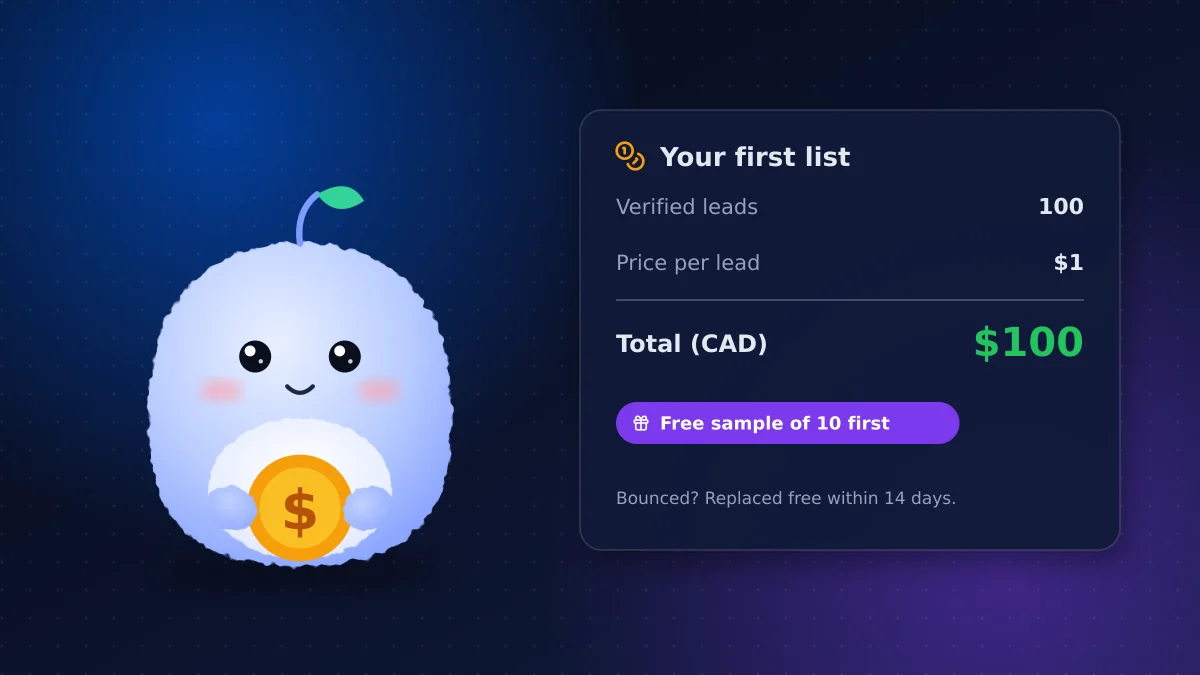
Verified leads start at $1 CAD each, with a 100-lead minimum, so a first list costs $100. Deeper research, like extra signals or custom fields, costs more and is quoted with your free sample.
Why is there a 100-lead minimum?
Every list needs the same setup: reviewing your brief, agreeing what counts as a fit and checking a free sample with you. The minimum covers that work and keeps the base price at $1 a lead.
What happens if a lead bounces?
If a business has closed or an email bounces within 14 days of delivery, tell us and we replace that lead free.
Can I see leads before I pay?
Yes. We send a free sample of 10 leads with your quote, and nothing is charged until you approve the full list.
Vaibhav Malhotra
Founder, VMR Technologies
Vaibhav Malhotra is the founder of VMR Technologies, where he leads the team building custom websites, e-commerce platforms, and AI solutions for businesses across the Greater Toronto Area and beyond. He writes about practical software and AI strategy for non-technical decision-makers — focused on what actually drives results rather than hype.