How Long Does It Take to Build a Website? Timelines by Site Type
Key takeaways
- A simple small business website usually takes 2 to 4 weeks; a custom marketing site with integrations, 6 to 12 weeks.
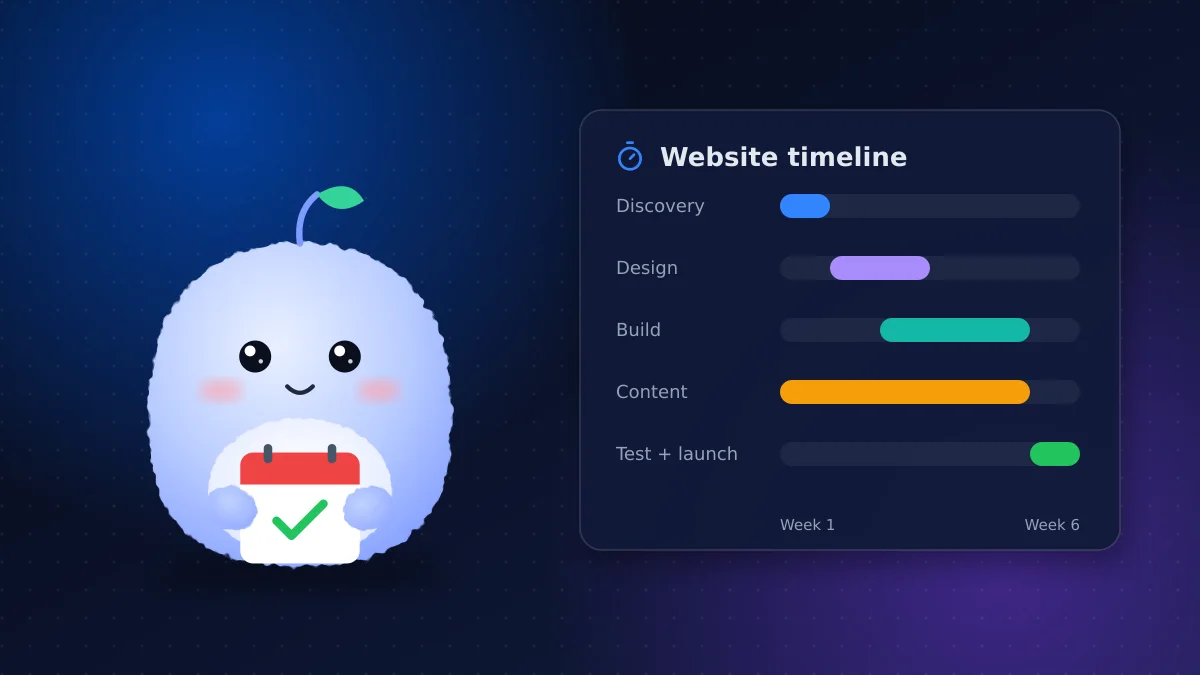
- Every project runs through the same phases: discovery, design, build, content, testing and launch.
- Late content and slow feedback cause more delays than development does.
- Agree on scope, one decision-maker and a feedback schedule before work starts.
- Launch a focused first version, then add pages and features once the site is live.
Ask a few web developers how long a website takes and you'll hear anything from "a weekend" to "six months." Both can be true, because the answer depends on what you're building and how the project is run. This guide gives typical timelines by site type, explains each phase and shows where projects usually stall.
The timelines below reflect how we plan projects at VMR. Your project may differ, but the phases and the common delays are much the same everywhere.
Typical website timeline by site type
| Site type | Typical timeline | What's included |
|---|---|---|
| Simple business site | 2 to 4 weeks | 4 to 6 pages, contact form, Google Business Profile link |
| Custom marketing site | 6 to 12 weeks | Custom design, CMS, booking or quote forms, integrations |
| E-commerce site | 8 to 16 weeks | Product catalog, payments, shipping and tax setup |
| Web app or portal | 3 months or more | Logins, dashboards, custom workflows |
An e-commerce site takes longer mainly because of product data. Writing descriptions, sizing photos and setting up variants for hundreds of products is real work, and it usually falls on the business.
The phases of a website project
1. Discovery phase (about 1 week)
The discovery phase is where you agree on goals, pages, features, integrations and who your customers are. It ends with a written scope and a fixed price. Skipping it is the most reliable way to make a project take longer later.
2. Design (1 to 3 weeks)
Wireframes and then visual designs for the key pages, usually the home page, a service page and a contact or booking page. Expect one or two rounds of changes.
3. Build (1 to 6 weeks)
Development of the pages, CMS, forms and integrations. Simple sites are quick; booking systems, payment flows and connections to other software add time.
4. Content (runs alongside)
Page copy, photos, team bios, service descriptions and FAQs. This phase starts on day one, even though it isn't technical.
5. Testing and launch (about 1 week)
Testing on phones and desktops, checking forms, speed and accessibility, setting up redirects from any old site and going live.
Getting ready before day one
You can shave weeks off a project by preparing before kickoff:
- Collect logins for your domain registrar, hosting, Google Business Profile and any booking or payment software
- List your services and the questions customers ask most
- Gather photos of your team, space and work
- Pick three sites you like and note what you like about each
- Name one decision-maker who can approve designs and copy
None of this needs technical knowledge, and all of it saves time later.
What slows website projects down
Content delays
Content delays are the number one cause of late launches. The design is approved, the build is ready, and the site waits weeks for page copy and photos. Avoid it by:
- Starting content in the first week, not after design
- Using a simple shared document for each page
- Asking your developer for help with copywriting if writing isn't your strength
Slow or scattered feedback
When five people give feedback at different times, every round takes twice as long. Pick one decision-maker and agree on a turnaround, such as two business days for each review.
Scope creep
New pages and features added mid-project push everything back. Keep a "phase 2" list and add ideas to it instead of the current build.
Third parties
Waiting on domain access, a booking software account or a payment provider's approval can stall launch. Gather logins and accounts during discovery.
How to launch faster without cutting corners
- Launch a focused first version. Get the pages that bring in customers live first.
- Use a proven structure. A custom design doesn't need a custom layout for every page.
- Batch your feedback into one consolidated list per round.
- Prepare your launch checklist early so nothing surprises you on launch day.
A simple launch checklist
- Forms tested and sending to the right inbox
- Redirects from old URLs in place
- Analytics and Google Search Console set up
- Google Business Profile updated with the new link
- Speed and mobile checks passed
If you're replacing an existing site, our website redesign SEO checklist covers how to keep your rankings through the switch. Google also has a helpful SEO starter guide on getting a new site found, and it notes that showing up in search takes time after launch.
Example: a six-page clinic website
Here's how a typical project for a small clinic with online booking might run. It's illustrative, not a promise:
| Week | Work |
|---|---|
| 1 | Discovery call, scope, sitemap and content plan |
| 2 | Home page design, with the clinic gathering photos and bios |
| 3 | Remaining page designs and first draft of copy |
| 4 to 5 | Build, booking system connection and content entry |
| 6 | Testing, fixes and launch |
The clinic's part — copy, photos, bios and booking software access — runs through the whole schedule. When those arrive late, launch moves with them.
Timeline and cost go together
Longer projects usually cost more because they involve more design, more integrations and more testing. For price ranges by site type, see how much a custom website costs.
Conclusion: plan the content, not just the build
So, how long does it take to build a website? For most small businesses, a few weeks for a simple site and two to three months for a custom one. The projects that launch on time are the ones that start content early, keep feedback tight and save new ideas for phase two.
Want a clear timeline and fixed price for your site? Tell us about your project.
Frequently asked questions
How long does a small business website take?
A simple small business site with four to six pages usually takes two to four weeks, as long as content and feedback arrive on time.
Why do website projects run late?
Most delays come from late content, slow or scattered feedback and new features added mid-project, not from the development itself.
How long does an e-commerce site take to build?
Usually eight to sixteen weeks, depending on the number of products, payment and shipping setup and integrations with inventory or accounting software.
What can I do to speed up my website project?
Start writing content in the first week, gather logins and photos before kickoff, choose one decision-maker for approvals and keep new feature ideas on a list for after launch.
Can a website be built in a week?
A very simple one-page or template site can be. A custom site with design, content and integrations needs more time to be done well, usually at least a few weeks.
Vaibhav Malhotra
Founder, VMR Technologies
Vaibhav Malhotra is the founder of VMR Technologies, where he leads the team building custom websites, e-commerce platforms, and AI solutions for businesses across the Greater Toronto Area and beyond. He writes about practical software and AI strategy for non-technical decision-makers — focused on what actually drives results rather than hype.