Portfolio Website for Photographers and Designers: What Wins Clients in 2026

Key takeaways
- Curate ruthlessly: a focused set of your best, most relevant work beats an archive.
- Image optimization is essential, because heavy photos are the main reason portfolio sites feel slow.
- Short case studies showing the brief, your approach and the result win commercial clients.
- An enquiry form that asks the right questions filters leads and saves back-and-forth.
- A custom portfolio site can start around $5,000; template platforms cost less but offer less control.
Your work may be excellent, but if your portfolio site is slow, cluttered or hard to contact you through, potential clients move on. The portfolios that consistently bring in work share a few traits. Here's what they get right.
Curation beats volume
The most common portfolio mistake is showing everything. Clients want to see that you can deliver the kind of work they need, quickly. Choose your strongest pieces, group them by the type of client you want more of, such as weddings, products or brand identity, and remove anything you wouldn't want to be hired to do again.
A portfolio layout that lets the work breathe
A good portfolio layout keeps the focus on the images:
- Large visuals with generous spacing and minimal decoration
- Clear categories so visitors find relevant work in one click
- Consistent thumbnails cropped to the same aspect ratio
- A simple navigation bar: Work, About, Services, Contact
- No autoplay music or slow intro animations
On mobile, which is where many clients first see your work, images should fill the screen and load in order as visitors scroll.
Image optimization: fast is non-negotiable
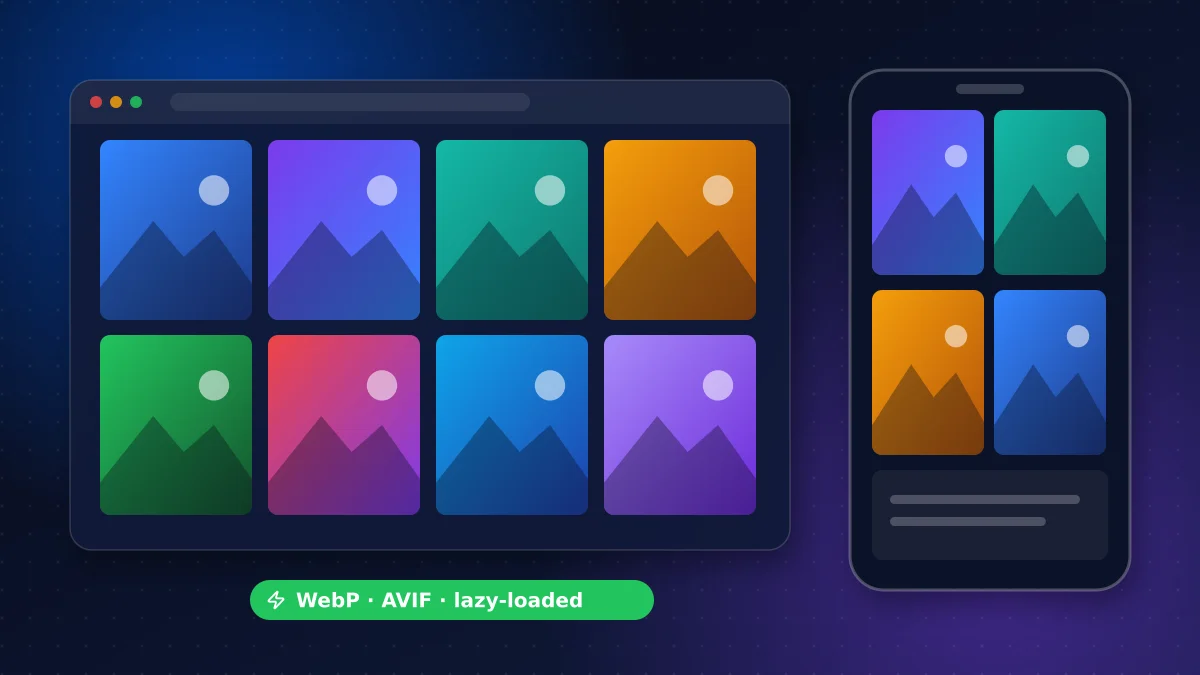
High-resolution photography is the main reason portfolio sites load slowly. Image optimization fixes that without visibly reducing quality:
- Serve modern formats such as WebP and AVIF
- Deliver different sizes for phones, tablets and large screens
- Lazy-load images below the fold
- Compress exports sensibly instead of uploading 20 MB originals
Google's guide to images on the web covers the techniques. Done well, a gallery of dozens of images can still feel instant.
Case studies win commercial work
For designers and commercial photographers, a few short case studies outperform a gallery alone. For each one, cover:
- The client and the brief
- Your approach and key decisions
- The final work, with process shots if they help
- The result: launch, campaign performance or the client's feedback
An About page that sells
Your About page is often the second page clients visit. Keep it personal and specific: who you are, what kind of work you love, how you work with clients and where you're based. Include a professional photo of yourself; people hire people. End with a clear link to your contact form.
Client testimonials and proof
Client testimonials build trust quickly, especially with a name, business and photo. Place a few near your work and your contact form. Logos of brands you've worked with, publications that featured you and awards add credibility, provided they're genuine.
A contact form that qualifies enquiries
Your contact form should make enquiring easy while giving you what you need to respond well:
- Name, email and phone
- Type of project and date, which matters for event photographers
- Budget range
- Location
- A short description
A clear form reduces vague "how much do you charge?" emails and helps you prioritize the right projects.
Should you show prices?
Many photographers and designers hesitate to publish prices. Showing at least a starting price, such as "wedding coverage from $3,500" or "brand identity projects from $6,000," filters out enquiries that will never fit your budget and attracts clients who are ready to book. If your work is highly custom, explain what drives the price and invite visitors to share their budget range in the contact form.
Use a personal domain
A personal domain, such as yourname.ca or yourstudio.com, looks more professional than a platform subdomain, makes your email address more credible, and keeps your search presence if you ever change platforms. It costs little and is worth securing early.
Local SEO for photographers and designers
Many clients search locally, for example "wedding photographer Mississauga" or "brand designer Toronto". To show up:
- Create service pages for what you offer, mentioning the areas you serve
- Set up and complete your Google Business Profile
- Write short, descriptive alt text for your images
- Ask happy clients for Google reviews
- Write blog posts about real shoots and projects with location details
Keep your portfolio fresh
Update your portfolio a few times a year. Add recent projects that represent the work you want more of, retire older pieces, and refresh your About page and testimonials. A portfolio that hasn't changed in two years suggests a business that hasn't either.
Make it accessible
Accessible portfolios reach more clients and rank better. Write meaningful alt text for every image, keep text readable against your backgrounds, make sure galleries and lightboxes work with a keyboard, and caption any video. These details also help search engines understand your work.
Track where enquiries come from
Add a "How did you hear about me?" field to your contact form and set up basic analytics. Within a few months you'll know whether clients find you through Google, Instagram, referrals or directories, and which portfolio pages they view before enquiring. Put your effort into the channels and categories that actually bring work, and trim the rest.
Template platform or custom site?
Template platforms are quick and affordable, a good start for a new photographer or designer. A custom portfolio site makes sense when you need a distinctive design, faster performance, client proofing or booking integrations, or full control over SEO. A custom portfolio site can start around $5,000. You can see an example in the photography portfolio we built for Nishchay Photography.
Conclusion: show less, load faster, make enquiring easy
A portfolio website for photographers and designers succeeds when it shows your best, most relevant work, loads quickly on every device, tells the story behind key projects and makes contacting you effortless. Combine that with a personal domain and basic local SEO, and your portfolio starts working as your best salesperson.
We design and build fast, image-first portfolio websites. Tell us about your work and we'll suggest a structure that shows it off.
Frequently asked questions
What should a photography or design portfolio website include?
A curated selection of your best work grouped by category, short case studies for key projects, an About page, client testimonials, clear services and an enquiry form that asks for project type, date, budget and location.
How many projects should I show in my portfolio?
Show fewer, stronger pieces. Focus on the work most relevant to the clients you want, grouped by category, and remove anything you wouldn't want to be hired to do again.
How do I make a portfolio website load faster?
Serve images in modern formats such as WebP or AVIF, deliver appropriately sized versions for each screen, lazy-load images below the fold and avoid uploading oversized originals.
How much does a portfolio website cost?
Template platforms cost a monthly subscription. A custom portfolio site with a distinctive design, optimized galleries and enquiry forms typically starts around $5,000.
Vaibhav Malhotra
Founder, VMR Technologies
Vaibhav Malhotra is the founder of VMR Technologies, where he leads the team building custom websites, e-commerce platforms, and AI solutions for businesses across the Greater Toronto Area and beyond. He writes about practical software and AI strategy for non-technical decision-makers — focused on what actually drives results rather than hype.