How to Choose a Data Annotation Company: A Buyer's Checklist
Key takeaways
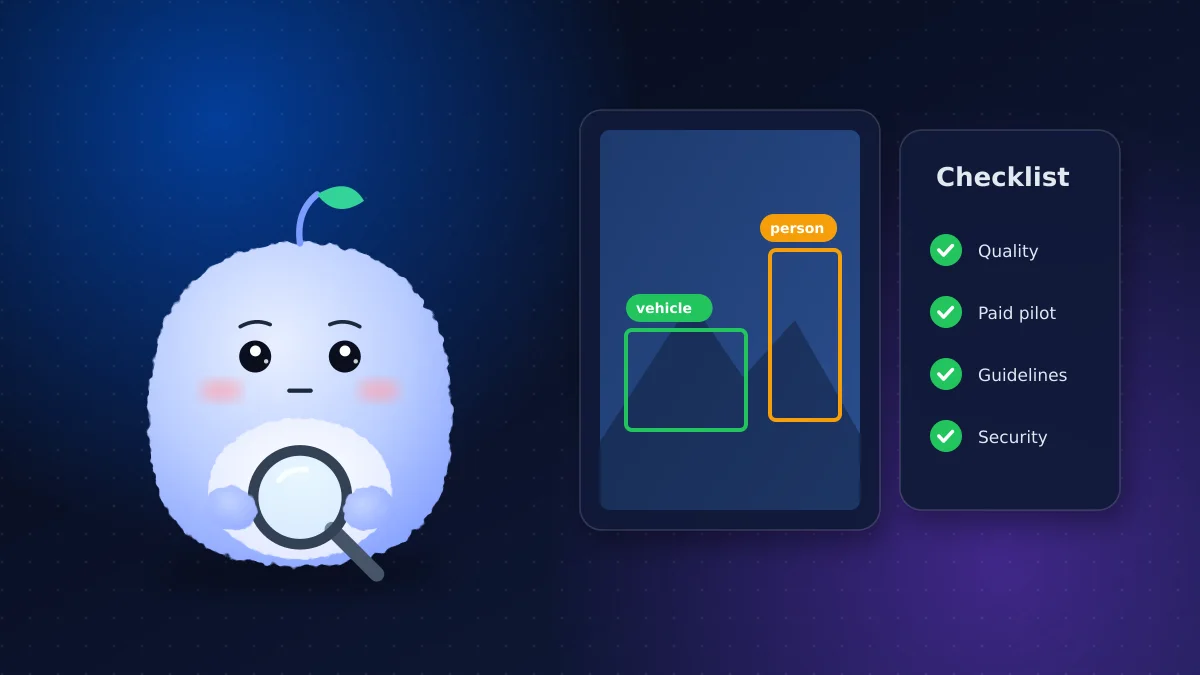
- Ask how annotation quality is measured: gold-standard checks, review layers and inter-annotator agreement.
- Run a paid pilot project on a representative sample before signing a large contract.
- Clear annotation guidelines, written together with the vendor, prevent most quality problems.
- Match data security to sensitivity: certifications, access controls, data residency and deletion terms.
The quality of a machine learning model is capped by the quality of its training data. That makes choosing an annotation partner one of the most important decisions in an AI project, and one of the easiest to get wrong by comparing only price per label. This checklist covers what to evaluate.
1. Start with your requirements
Before contacting vendors, define:
- Data type: images, video, text, audio or documents
- Task: classification, bounding boxes, segmentation, entity tagging and so on
- Volume and timeline, including future batches
- Domain expertise needed, such as medical, legal or engineering
- Sensitivity: personal, health or confidential business data
Vendors can only quote accurately against a clear brief.
2. How annotation quality is measured
Every vendor says its quality is high. Ask how it's measured:
- Gold-standard checks: a set of items with known correct labels, mixed into the work to score annotators
- Review layers: what share of work gets a second review, and by whom
- Inter-annotator agreement: how consistently different annotators label the same items, often measured with statistics such as Cohen's kappa
- Error categories: how mistakes are tracked and fed back into training
Ask for real quality reports from a past project, anonymized if necessary.
3. Insist on a pilot project
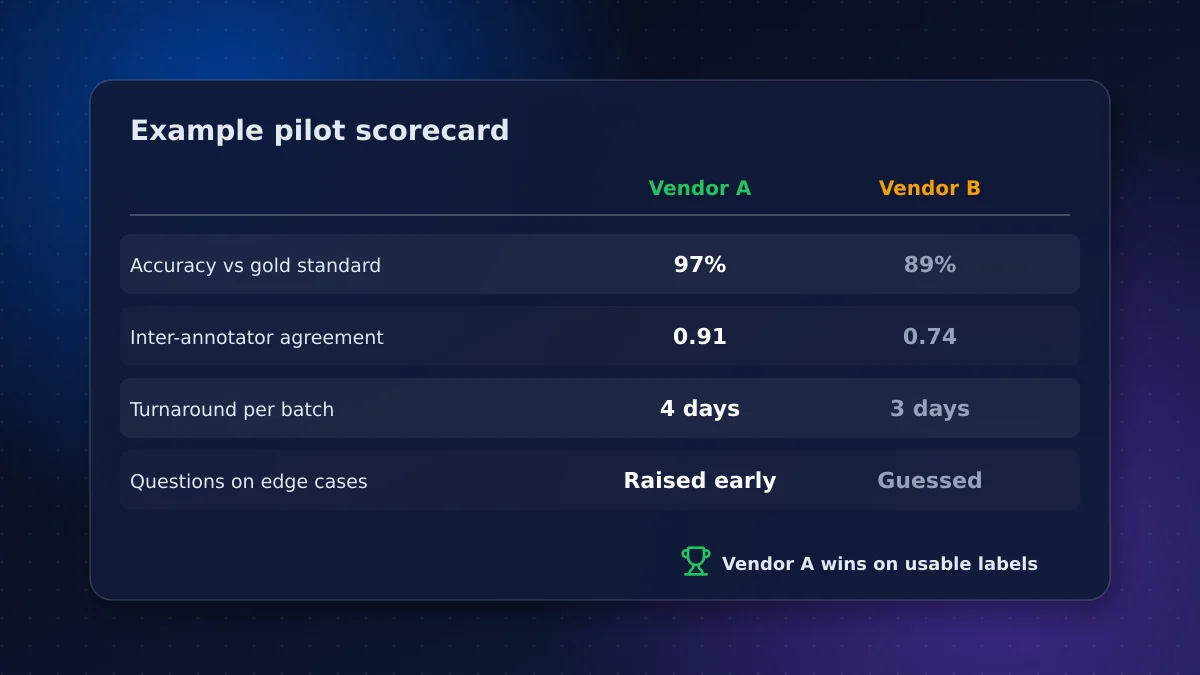
A paid pilot project on a representative sample of your data is the best predictor of how a full engagement will go. Use it to test:
- Label accuracy against your own gold standard
- How the vendor handles ambiguous cases and questions
- Turnaround time and communication
- How quickly feedback improves the next batch
4. Annotation guidelines: build them together
Most annotation problems trace back to unclear instructions. Strong annotation guidelines define every label, include examples and counter-examples, and explain how to handle edge cases. A good vendor will help write and refine them, and will flag ambiguities during the pilot rather than guessing.
5. Workforce and expertise
Ask who does the work: a trained in-house team, a managed workforce or an open crowd. For specialized domains such as medical imaging, ask about annotators' qualifications and how expert reviewers are involved. Ask how the vendor handles annotator turnover on long projects, too.
6. Data security and privacy
Match data security to the sensitivity of your data:
- Certifications such as ISO/IEC 27001 or SOC 2 reports
- Access controls: secure tools, no local downloads, logged access
- Data residency: where data is stored and processed, which matters for Canadian personal and health information
- Personal information: redaction or de-identification before annotation where possible
- Deletion: written confirmation that data is deleted at the end of the contract
- Agreements: NDAs and data processing terms that reflect your privacy obligations
7. Tooling and formats
Confirm the vendor can deliver in the formats your pipeline uses, such as COCO, YOLO or JSON, and ask which annotation tools they use. Open-source platforms such as CVAT and Label Studio are common. Make sure you'll own the labels and can export everything without lock-in.
8. Pricing models
Vendors typically price per label, per hour or per task. Per-label pricing is predictable for simple tasks; hourly pricing suits complex or variable work. Compare total cost per usable label, after rework, rather than headline rates. Our guide to data annotation costs breaks down typical ranges.
Questions to ask on the first call
- Which similar projects have you delivered, in our data type and domain?
- How do you measure and report quality, and how often?
- Who reviews the work, and what share of it?
- How do you handle ambiguous items and annotator questions?
- Can you run a paid pilot on our data first?
- Where will our data be stored and processed, and who can access it?
- How do you handle annotator turnover on long projects?
- What formats can you deliver, and do we own all labels?
Managing the vendor after you sign
Quality tends to drift over long projects as guidelines evolve and teams change. Keep a gold-standard set in every batch, review quality reports weekly at the start and monthly once stable, and hold short calibration sessions when the guidelines change. Treat the vendor as an extension of your ML team: share how the model is performing and where it struggles, so annotators know which edge cases matter most.
Specialized data types
Some projects need more than general annotation skills:
- Medical imaging needs qualified annotators and expert review, plus strict health-data safeguards
- Documents and forms need annotators who understand the layouts and terminology, such as invoices or legal agreements
- Audio and speech need annotators fluent in the languages and accents in your data
- Video and 3D sensor data need specialized tools and consistent tracking across frames
Ask for evidence of experience with your specific data type, not just annotation in general.
When to keep annotation in-house
In-house annotation can make sense for small, highly confidential or rapidly changing datasets, or when only your own experts can make the judgments. Many teams combine approaches: experts label the gold standard and difficult edge cases internally, and a vendor scales the volume.
Red flags
- No paid pilot, or a pilot only on the vendor's own sample data
- Vague answers about quality measurement
- No written process for edge cases and questions
- Unclear data handling or deletion terms
- Prices far below the market for complex tasks
Conclusion: buy quality, measure it, then scale
Knowing how to choose a data annotation company comes down to evidence: measurable quality, a pilot on your own data, clear guidelines and security that matches your data. Price matters, but only after a vendor proves it can deliver labels your model can learn from.
VMR provides AI annotation services with documented quality processes and secure handling. Request a pilot on a sample of your data and judge the results for yourself.
Frequently asked questions
How do I compare data annotation companies?
Compare measurable quality processes, results from a paid pilot on your own data, guideline development, workforce expertise, data security and the total cost per usable label after rework, not just the headline price.
What is inter-annotator agreement?
It measures how consistently different annotators label the same items. High agreement suggests clear guidelines and reliable labels; low agreement signals ambiguity that needs fixing before scaling up.
Should I run a pilot before hiring an annotation vendor?
Yes. A paid pilot on a representative sample of your data shows real accuracy, turnaround and communication before you commit to a large contract.
How do annotation vendors keep sensitive data secure?
Look for certifications such as ISO/IEC 27001 or SOC 2, secure tools with no local downloads, logged access, clear data residency, redaction of personal information where possible, and written deletion at the end of the contract.
Vaibhav Malhotra
Founder, VMR Technologies
Vaibhav Malhotra is the founder of VMR Technologies, where he leads the team building custom websites, e-commerce platforms, and AI solutions for businesses across the Greater Toronto Area and beyond. He writes about practical software and AI strategy for non-technical decision-makers — focused on what actually drives results rather than hype.