Cold Email in Canada: CASL Rules for Contacting Businesses
Key takeaways
- CASL's conspicuous publication rule can give implied consent to email a published business address, but only when all three conditions are met.
- Addresses mined from third-party directories generally don't qualify, following a 2020 Federal Court of Appeal ruling.
- Your message must relate to the recipient's business role, not just their job title.
- Every commercial email needs sender identification and an unsubscribe that's honoured within 10 business days.
- The sender must prove consent, so record where and when you found each address.
Cold outreach is a normal part of B2B sales, but Canada's Anti-Spam Legislation (CASL) treats it differently from the US. Under CASL, you need consent before sending a commercial email, and "cold" means you don't have express consent yet. This guide explains when implied consent can cover a first email to a business and how to keep the proof. It's a practical overview, not legal advice.
Is cold email legal in Canada?
Sometimes. A sales email is a commercial electronic message (CEM): any electronic message that encourages someone to take part in a commercial activity. CASL requires consent for every CEM, either express (they opted in) or implied (a situation set out in the law).
For cold outreach, the implied consent that usually matters is conspicuous publication. When it applies, you can send a relevant message to a business address without asking first. When it doesn't, the email needs express consent, which a cold message by definition doesn't have.
The conspicuous publication rule
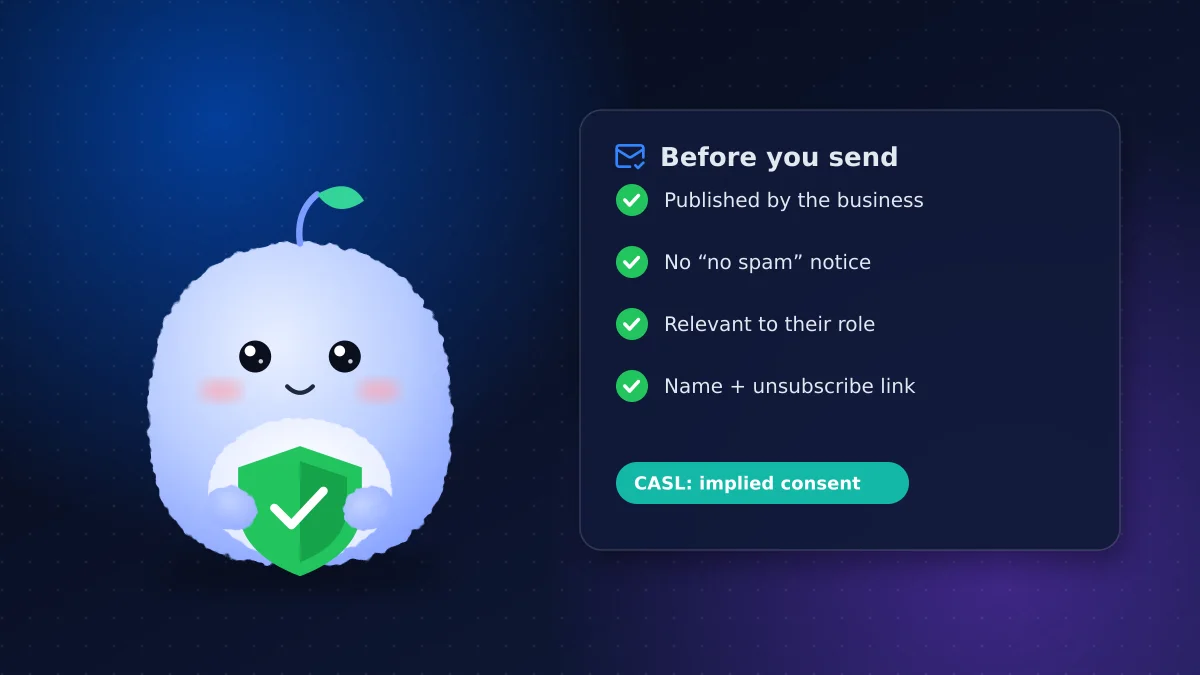
Under section 10(9)(b) of CASL, you have implied consent to email an address when all three of these are true:
- The person published the address conspicuously, or had it published, such as on their business's own website
- The publication doesn't say they don't want unsolicited commercial messages at that address
- Your message relates to their business, role, functions or duties in a business or official capacity
All three must hold. The CRTC's guidance on implied consent says it decides these cases one at a time, based on whether consent can reasonably be inferred for that particular email.
What "relevant to their role" means
Relevance is where many campaigns fail. Offering booking software to the published front-desk address of a dental clinic relates to how that clinic runs. Sending the same address an unrelated offer, such as a personal investment pitch, doesn't.
In its 2020 ruling, the Federal Court of Appeal also said a person's job title isn't the same as their business role or duties. Being a "manager" doesn't make any offer aimed at managers relevant to them.
Why third-party directories are a problem
In 3510395 Canada Inc. v. Canada (Attorney General), 2020 FCA 103, the Federal Court of Appeal upheld a CRTC penalty against a training company that emailed addresses gathered from websites. The company couldn't show the recipients had published those addresses themselves, and some came from sites that said not to send unsolicited messages. The Supreme Court of Canada declined to hear an appeal in 2021.
The practical lesson, as this law firm summary of the ruling puts it, is that conspicuous publication generally doesn't cover addresses mined from third-party directories. Lists scraped from directories are a weak basis for cold email in Canada, however cheap they are.
What every commercial electronic message must include
Consent isn't enough on its own. Every commercial electronic message also needs:
- Identification: your business name, and the business you're sending for if that's different
- Contact information: a mailing address plus a phone number, email or web address
- An unsubscribe mechanism: free and easy to use, kept working for at least 60 days after sending
Unsubscribe requests must be honoured without delay, and within 10 business days at most. This applies to every email in a follow-up sequence, not just the first one.
Keeping proof of implied consent
Under CASL, the sender has to prove consent. For every address you rely on conspicuous publication for, record:
| Record | Example |
|---|---|
| Where it was published | The business's contact page URL |
| When you saw it | The date you checked the page |
| That there was no "no marketing" notice | A note or screenshot of the page |
| Why your message is relevant | The signal, like "Booking is phone-only" |
Keep these with the contact in your CRM or spreadsheet. If a recipient complains, you can show exactly why you had a basis to write to them.
A compliant cold email, step by step
- Find the address on the business's own website or listing, and record the page and date.
- Check the page for a "no solicitation" notice. If there is one, don't email that address.
- Make sure your offer relates to the role behind the address, such as the front desk, owner or office manager.
- Write a short, specific email that says why you're contacting this business.
- Include your identification, contact details and an unsubscribe link.
- Stop after one or two follow-ups, and remove anyone who opts out within 10 business days.
- Invite express consent if you want to keep them on a list, such as "Want our monthly tips? Reply yes."
Common cold email mistakes
- Guessing addresses with patterns like firstname@business.ca. A guessed address was never published, so the rule can't apply.
- Using personal emails you found on social media or elsewhere
- Leaving the unsubscribe link out of follow-ups, or sending from a tool that doesn't support one
- Sending one generic pitch to every address, which makes relevance hard to show
- Importing a bought list into a sales tool without knowing where each address came from
Penalties for getting it wrong
The CRTC enforces CASL and can impose administrative penalties of up to $10 million per violation for organizations and $1 million for individuals. Our guide to CASL compliance for small business covers sign-up forms, express consent and record-keeping for your wider email marketing.
Conclusion: start with addresses you can defend
Cold email in Canada works best when it's narrow and traceable: addresses the business published itself, a message that fits the recipient's role, and clear identification with a working unsubscribe. That's slower than blasting a directory list, but it's defensible, and it gets more replies.
Every lead on our prospect lists comes with contact details the business published itself and a note of where we found them, from $1 a lead. Want help planning compliant outreach? Send us a quick note.
Frequently asked questions
Is cold emailing businesses legal in Canada?
It can be. CASL gives implied consent to email an address the business published itself, with no notice refusing marketing messages, when your message relates to the recipient's role. Otherwise you need express consent.
Can I email addresses from an online directory?
Generally not on the basis of conspicuous publication. The Federal Court of Appeal ruled in 2020 that addresses mined from third-party directories usually don't qualify, because you can't show the recipient published them.
Does every cold email need an unsubscribe link?
Yes. Every commercial electronic message needs an unsubscribe mechanism that works for at least 60 days, and opt-outs must be honoured within 10 business days.
Is info@ or a general business address okay to email?
A general address the business published on its own website can qualify, as long as there's no notice refusing marketing messages and your message is relevant to the business.
Vaibhav Malhotra
Founder, VMR Technologies
Vaibhav Malhotra is the founder of VMR Technologies, where he leads the team building custom websites, e-commerce platforms, and AI solutions for businesses across the Greater Toronto Area and beyond. He writes about practical software and AI strategy for non-technical decision-makers — focused on what actually drives results rather than hype.