CDAP Replacement 2026: What Funds Websites and AI Projects in Canada Now
Key takeaways
- CDAP's grants and its interest-free BDC loan closed to new applicants in 2024; pages still promising them are out of date.
- BDC LIFT ($500M, launched April 2026) is the closest successor for AI projects, but it is a loan with revenue and profitability requirements.
- Ontario businesses can still get a matched grant of up to $15,000 to plan technology investments through the Digital Modernization and Adoption Plan.
- SR&ED only covers work that resolves genuine technological uncertainty; a standard website build does not qualify.
- Most programs will not reimburse work started before approval, so line up funding before you sign a development contract.
If you budgeted a website or AI project around the Canada Digital Adoption Program, the plan needs a rewrite. This guide maps what is actually open in 2026, who qualifies, and how to scope a project so it fits the money.
What happened to CDAP?
CDAP had two streams. Grow Your Business Online offered a $2,400 micro-grant for e-commerce and web presence. Boost Your Business Technology paid up to $15,000 toward a digital adoption plan and unlocked an interest-free BDC loan of up to $100,000 to implement it.
Both streams closed to new applicants in 2024. Plenty of blogs and agency pages still describe them as available, so check the date on anything you read. There is no like-for-like federal replacement; instead, the 2026 picture is a stack of programs you combine.
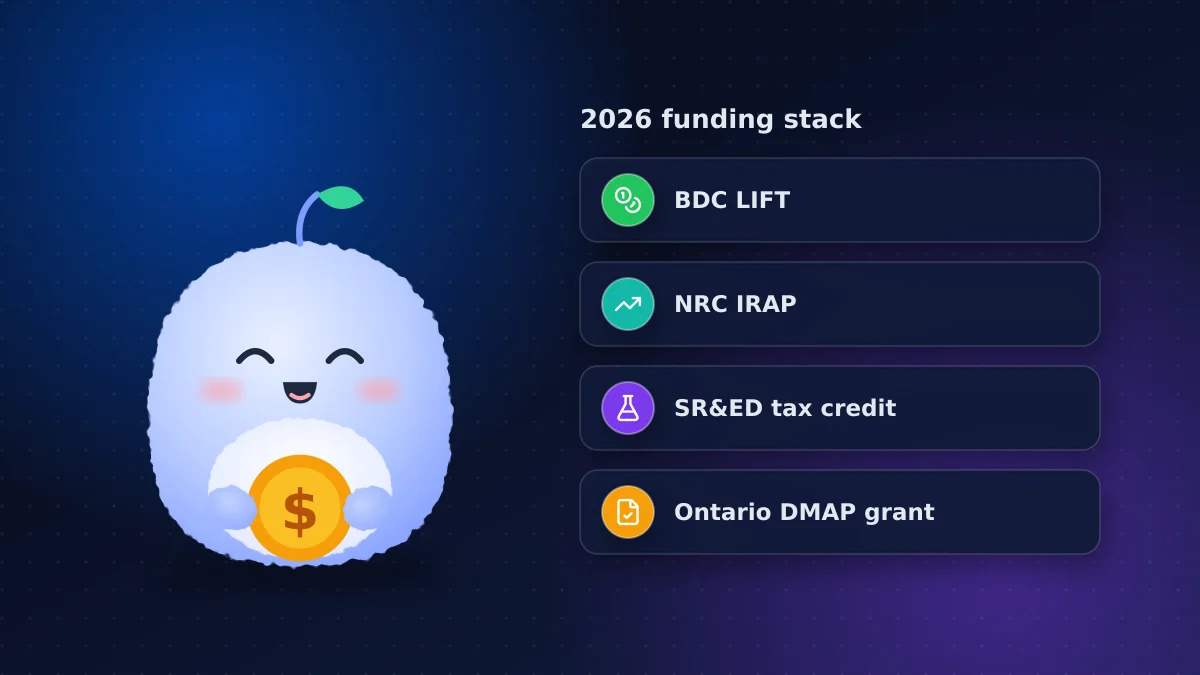
The 2026 funding stack at a glance
| Program | Type | Who it's for | Websites? | AI projects? |
|---|---|---|---|---|
| BDC LIFT | Loan ($25K–$2M for software-first AI) | Canadian businesses with $1M+ revenue | Only within a wider digital plan | Yes, its core purpose |
| NRC IRAP | Non-repayable contributions plus advisors | Incorporated SMEs with 500 or fewer staff | Rarely | Yes, where real technical work exists |
| SR&ED | Refundable tax credit (35% enhanced rate for CCPCs) | Corporations doing qualifying R&D | No | Only experimental development |
| Ontario DMAP | Matched grant up to $15,000 | Ontario SMEs | Planning only | Planning only |
| Alberta Innovates Voucher | $10,001–$100,000 voucher | Alberta-incorporated SMEs | No | Yes, for commercialization |
BDC LIFT: the closest successor for AI adoption
BDC launched LIFT in April 2026 as a $500 million program under the federal AI for All strategy. Loans run from $25,000 to $2 million for software-first AI projects, with larger caps for physical AI, amortization of up to six years and an option to postpone capital repayments for up to twelve months.
The catches matter. You need at least $1 million in annual revenue, a profitable track record and good credit. You must also complete a paid BDC Advisory Services digital plan (which BDC can finance), and the project needs at least one Canadian component.
IRAP AI Assist and core IRAP funding
NRC IRAP pairs businesses with industry technology advisors and funds projects with real technical risk. Its AI Assist initiative channels support for AI planning and pilots through approved non-profit and post-secondary partners. Eligible companies are incorporated, for-profit and have 500 or fewer employees. IRAP is relationship-driven: talk to an advisor before you write a proposal.
The SR&ED tax credit for experimental development
The SR&ED tax credit rewards work that resolves technological uncertainty, such as a novel algorithm, a model that existing techniques cannot make work, or an integration problem with no known solution. Budget 2025 moved to raise the enhanced-rate expenditure limit to $6 million for tax years beginning on or after December 16, 2024, and to add an optional pre-claim approval process; confirm the current status with your accountant.
What does not qualify: routine web development, theme customization, or training a model with well-established methods. If you hire an outside developer, arm's-length contract payments can generally be claimed at 80%, but only by one party, so settle who claims in the contract.
Ontario's Digital Modernization and Adoption Plan
Ontario's Digital Competence Centre, run by the Ontario Centre of Innovation, offers a matched grant of up to $15,000 through the Digital Modernization and Adoption Plan. You work with a Digital Adoption Consultant to build a technology roadmap. Completing it can unlock a larger matched Technology Demonstration grant for implementation, and eligible retailers can apply for a smaller Retail Modernization grant of up to $5,000. Ontario added another $5 million to the centre in 2026. This applies across the province, from the GTA to Ottawa.
Alberta Innovates Voucher for Calgary and Edmonton
Alberta Innovates offers vouchers of $10,001 to $100,000 for Alberta-incorporated SMEs with fewer than 500 employees and under $50 million in revenue, with a 25% cash contribution. It funds product R&D, prototyping and commercialization, which makes it a fit for building an AI-powered product, not for a marketing website.
Businesses in British Columbia rely mostly on the federal stack: LIFT, IRAP and SR&ED. The federal strategy also earmarks $500 million for a Regional AI Initiative delivered through regional development agencies, so watch PacifiCan and FedDev Ontario for intakes.
How to scope a project so it's fundable
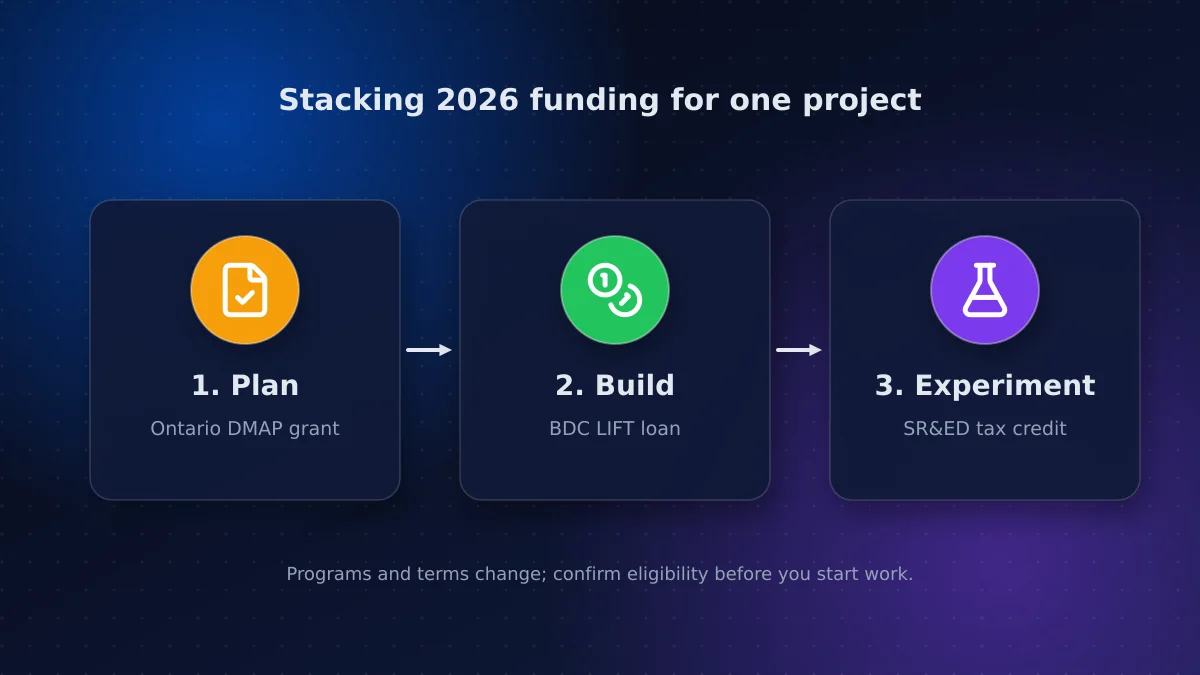
Funding rewards projects that are planned before they are built. In practice:
- Split the plan from the build. DMAP and LIFT both start with a plan, so a clear discovery phase is an asset, not overhead.
- Document technical uncertainty as you go. SR&ED claims live or die on contemporaneous notes, experiments and results.
- Name the Canadian component. LIFT requires one; a Canadian development partner can count.
- Don't start early. Many programs will not cover costs incurred before approval.
- Check stacking rules. Combining grants, loans and tax credits is allowed, but government assistance can reduce your SR&ED-eligible expenditures.
What funding usually won't pay for
A redesign of a marketing website rarely qualifies on its own, and neither do ongoing software subscriptions, advertising or work already completed. If the website is part of a broader digital transformation, such as online ordering tied to inventory or an AI assistant tied to your CRM, it can sit inside a funded plan. Our breakdown of what an AI agent costs to build is a useful starting point for sizing an AI line item.
Conclusion: plan the project, then match the money
The CDAP era of easy $15,000 grants is over, but there is more money aimed at AI adoption in 2026 than ever, mainly as loans, tax credits and matched grants. The businesses that get it have a scoped plan, realistic numbers and the paperwork to prove what is experimental.
Program terms change often, so confirm details on each program's site and with your accountant; this is not tax or financial advice. If you want a project scoped so it's ready for a DMAP consultant, a LIFT digital plan or an SR&ED claim, tell us what you're planning and we'll map it to the programs that fit.
Frequently asked questions
Is the Canada Digital Adoption Program still available in 2026?
No. Both CDAP streams, the $2,400 Grow Your Business Online grant and the Boost Your Business Technology grant with its interest-free BDC loan, closed to new applicants in 2024. Pages that still describe them as open are out of date.
What replaced CDAP for Canadian small businesses?
Nothing replaced it one-for-one. In 2026 the main options are BDC's LIFT loans for AI adoption, NRC IRAP for projects with technical risk, the SR&ED tax credit, Ontario's Digital Modernization and Adoption Plan grant of up to $15,000, and Alberta Innovates vouchers.
Can I get a government grant for a business website in Ontario?
Not usually for a standalone marketing site. Ontario's Digital Modernization and Adoption Plan funds up to $15,000 of matched planning work, and eligible retailers can apply for a modernization grant of up to $5,000. A website that is part of a wider digital plan has a better chance.
Does SR&ED cover website or AI development?
SR&ED covers work that resolves genuine technological uncertainty, such as novel algorithms or problems existing techniques cannot solve. Routine web development and training models with established methods generally do not qualify. Talk to an SR&ED specialist before you start.
Vaibhav Malhotra
Founder, VMR Technologies
Vaibhav Malhotra is the founder of VMR Technologies, where he leads the team building custom websites, e-commerce platforms, and AI solutions for businesses across the Greater Toronto Area and beyond. He writes about practical software and AI strategy for non-technical decision-makers — focused on what actually drives results rather than hype.